Concentration Calculations: % w/v, Ratio Strength, ppm and mmol
· 4 min read
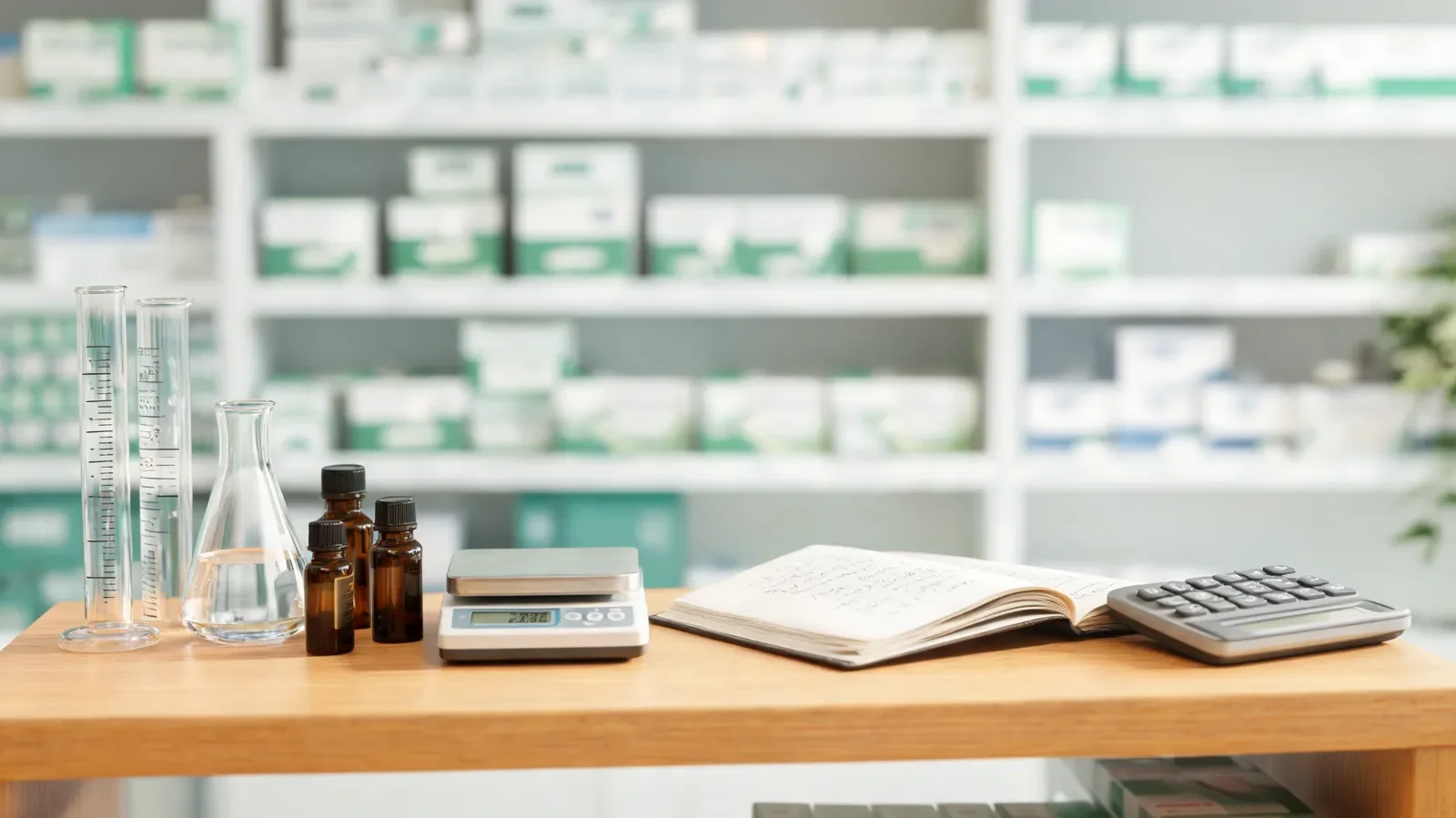
Concentration calculations in pharmacy all convert to one idea: how much drug is in a given amount of product. Percentage strength, ratio strength, parts per million and millimoles are just different ways of writing that amount. Learn what each one means in grams and millilitres, and you can move between them in one line. This guide covers each form with worked examples for the GPhC registration assessment.
Concentrations and dilutions are both on the list of calculation areas the GPhC's Common Registration Assessment framework says will appear in every Part 1 paper. They also turn up inside other questions, such as infusion rates and doses, so a solid method here earns marks across the whole paper.
Percentage strength: w/v, w/w and v/v
Percentage always means "per 100".
| Expression | Means | Example |
|---|---|---|
| % w/v | grams of solute in 100 mL of product | 5% w/v = 5 g in 100 mL |
| % w/w | grams of solute in 100 g of product | 1% w/w cream = 1 g in 100 g |
| % v/v | mL of liquid in 100 mL of product | 70% v/v = 70 mL in 100 mL |
The fastest conversion to remember: for % w/v, multiply by 10 to get mg/mL. So 5% w/v is 50 mg/mL, 0.9% w/v is 9 mg/mL, and 0.1% w/v is 1 mg/mL.
Worked example: grams in a bag
How many grams of glucose are in 500 mL of glucose 5% w/v?
5 g per 100 mL, so 500 mL contains 5 x 5 = 25 g.
Ratio strength: "1 in x"
Ratio strength tells you that 1 part of drug is in x parts of product. For solids in liquids, 1 in 1,000 means 1 g in 1,000 mL.
The example every pharmacist knows is adrenaline:
- Adrenaline 1 in 1,000 = 1 g in 1,000 mL = 1 mg/mL (0.1% w/v)
- Adrenaline 1 in 10,000 = 1 g in 10,000 mL = 100 micrograms/mL (0.01% w/v)
Worked example: volume for a dose
How many mL of adrenaline 1 in 1,000 contain 500 micrograms?
1 in 1,000 is 1 mg/mL, which is 1,000 micrograms/mL. So 500 micrograms is in 0.5 mL.
To convert any ratio strength to a percentage, divide 100 by x. For 1 in 1,000: 100 / 1,000 = 0.1%.
Parts per million (ppm)
Parts per million is used for very dilute solutions. For a weight in volume:
1 ppm = 1 g in 1,000,000 mL = 1 mg per litre
Worked example: ppm to a mass
A solution contains 50 ppm of a substance. How much is in 200 mL?
50 ppm = 50 mg/L = 50 mg in 1,000 mL. In 200 mL: 50 x 200 / 1,000 = 10 mg.
Millimoles: when the question talks about ions
Electrolyte questions often ask for millimoles (mmol) rather than mass. You need the molecular mass, which the question will give you.
mmol = mass (mg) / molecular mass
For a salt that splits into one of each ion, such as sodium chloride or potassium chloride, 1 mmol of the salt gives 1 mmol of each ion.
Worked example: sodium in 0.9% saline
How many mmol of sodium are in 1 litre of sodium chloride 0.9%? (Molecular mass of NaCl = 58.44)
- 0.9% w/v = 9 g per litre = 9,000 mg.
- 9,000 / 58.44 = 154 mmol of sodium chloride.
- One sodium ion per molecule, so 154 mmol of sodium per litre.
That matches the figure you will see on bags of sodium chloride 0.9%, which is a useful way to check your method.
Worked example: potassium from a mass of salt
How many mmol of potassium are in 1.5 g of potassium chloride? (Molecular mass of KCl = 74.55)
1,500 mg / 74.55 = 20.1, so about 20 mmol of potassium.
Dilutions: C1 x V1 = C2 x V2
When you dilute a solution, the amount of drug stays the same; only the volume changes. So:
Starting concentration x starting volume = final concentration x final volume
Worked example: making a weaker solution
How much 5% w/v stock solution do you need to make 500 mL of a 0.05% w/v solution?
- 5 x V1 = 0.05 x 500
- V1 = 25 / 5 = 5 mL of stock, made up to 500 mL with diluent.
Keep both concentrations in the same units. If one is a percentage and the other is a ratio strength or mg/mL, convert first.
A conversion table worth memorising
| Ratio strength | % w/v | mg/mL | micrograms/mL |
|---|---|---|---|
| 1 in 100 | 1% | 10 | 10,000 |
| 1 in 1,000 | 0.1% | 1 | 1,000 |
| 1 in 10,000 | 0.01% | 0.1 | 100 |
| 1 in 100,000 | 0.001% | 0.01 | 10 |
Common mistakes to avoid
- Treating % w/w like % w/v. A cream is measured by weight, so 1% w/w is grams per 100 g, not per 100 mL.
- Losing a factor of 1,000. Write every unit in your working, and write "micrograms" in full.
- Diluting the wrong way round. The final concentration should always be weaker than the stock. If yours is stronger, you have swapped the volumes.
- Answering a different question. Check whether you are asked for the volume of stock or the volume of diluent to add. In the example above the stock is 5 mL, but the diluent is 495 mL.
Turn the method into marks
Pick ten concentration questions and ten dilution questions, and time yourself at about 3 minutes each, which is the pace the GPhC suggests for Part 1. If any type keeps catching you, drill that one until it is automatic.
Concentration skills feed straight into infusion questions, so work through our infusion rate calculations with worked examples next. You can also sit a free timed mock paper to see how these questions feel under exam conditions.